

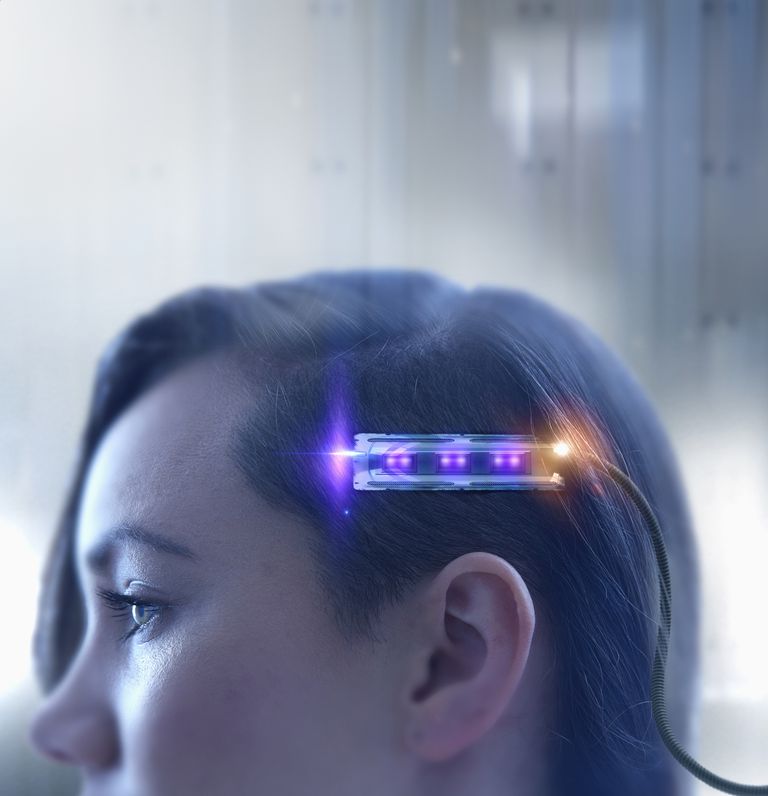
Is it possible for several people to connect brain to share their thoughts and perform specific tasks together? It seems like science fiction but yes, this is just what has been successfully tested by an American group of neuroscientists at the University of Washington and Carnegie Mellon University.
The goal was to make a three-way brain connection to allow three people to share their thoughts in order to play a collaborative game (similar to Tetris).
The novel system is known as BrainNet, and its authors say it could be used to connect many different minds, including through the Internet.
But, in addition to opening up new forms of communication, BrainNet could teach us more about how the human brain works.
“As far as we know, BrainNet is the first non-invasive direct interface between brain and brain for collaborative problem solving,” they noted.
“The interface allows three human subjects to collaborate and solve a task using direct brain-to-brain communication,” they add.
In the experiment two ’emitters’ were connected to EEG electrodes and they were asked to play Tetris-style game that involved falling blocks. They had to decide if each block should turn or not.
For this, they were asked to observe one of the two LEDs that blinked on each side of the screen (one at 15 Hz and the other at 17 Hz), which produced different signals in the brain that the EEG could capture. options were transmitted to a single ‘receiver’ through to TMS cap that could generate flashes of phantom light in the receiver’s mind, known as phosphenes.
The receiver could not see the entire playing area, but had to turn the falling block if a flash signal was sent.
In five different groups of three people, the researchers reached an average precision level of 81.25%, remove high for a first attempt.
To add extra complexity to the game, the ‘senders’ could add a second round of comments indicating whether the ‘receiver’ had made the correct call.
The ‘receptors’ were able to detect which of the ’emitters’ were more reliable based on brain communications, which, according to the researchers, is promising for the development of systems that deal with more real scenarios in the world in which the Lack of human confidence would be a factor.
And while the current system can only transmit one ‘bit’ (or flash) of data at a time, the team of experts thinks that the configuration can be extended in the future.
The same group of researchers has been able to successfully unite two brains, getting participants to play a game of 20 questions against each other. Again, phantom phosphene flashes were used to transmit information, in this case “yes” or “no”.
For now, the data obtained from the study are not totally reliable (and this work has yet to be reviewed by the neuroscientific community), but it is a curious example that makes us glimpse new ways with which we could communicate in the future, perhaps even combining mental resources to try to address important problems.
“Our results raised the possibility of future brain-brain interfaces that allow the cooperative resolution of problems by human beings using a ‘social network’ of connected brains,” says the research team.