

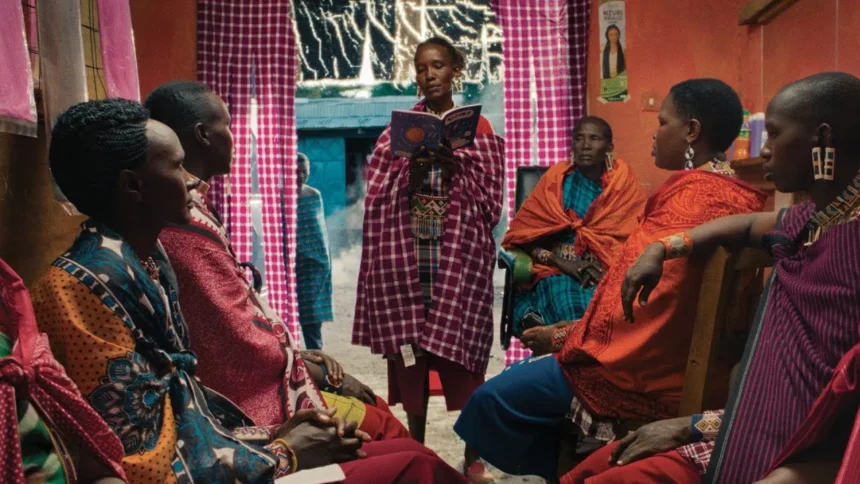
Vincho Nchogu’s feature directorial debut, One Woman One Bra, explores the complicated relationship between authentic African stories and the narratives that foreign institutions sometimes expect to see. The Kenyan-Nigerian co-production grew from Nchogu’s own experience producing promotional material for NGOs across East Africa, where she witnessed how complex human stories could be reshaped into simple narratives of hardship, rescue and redemption. That experience became the foundation for a film that questions who gets to tell African stories and what happens when communities are presented through the expectations of outsiders. The film premiered at the Venice Film Festival in 2025 in the Biennale College Cinema section before winning the Sutherland Award for Best First Feature at the BFI London Film Festival. What began as a story centred on land rights gradually developed into a more personal feminist character study, placing one woman’s struggle for belonging at the centre of a wider examination of culture, identity and foreign influence.
One Woman One Bra follows Star, played by Sarah Karei, a woman who lives on the margins of her Maa community and moves through the area on her boda boda. She has no close family of her own and exists outside the conventional expectations placed on women around her. The women in the community view marriage and motherhood as central parts of life, while Star appears to have deliberately chosen a different path after rejecting a marriage proposal from an older man. Her independence initially appears to be something she accepts without much difficulty, but that changes when title deeds are distributed according to family connections. Suddenly, the absence of a recognised family lineage places her home and future at risk, forcing her to confront a system that leaves little room for someone who exists outside its traditional structures.
Star’s attempt to establish her lineage becomes the driving force behind the story, but the film does not always provide clear answers about what family, tradition or belonging mean to her. Her search takes her through a series of increasingly complicated situations as she attempts to protect her home and find a place within a community that continues to keep her at a distance. Her relationship with the people around her remains unstable, with acceptance and rejection appearing to depend on circumstances rather than any consistent set of principles. This uncertainty creates some of the film’s strongest comedic situations, but it also weakens the emotional development of its central character. Star is resourceful when circumstances demand it, yet her journey does not always give her the clear personal transformation that the story seems to promise.
The film’s connection to the Loita community is one of its most distinctive qualities. Nchogu shot the production in the area, allowing the landscape and local community to become an important part of the storytelling rather than simply serving as a backdrop. Local non-actors appear alongside the professional cast, bringing a natural energy to scenes that might otherwise feel overly scripted. Their performances may not always have the technical precision associated with experienced actors, but their presence gives the film moments of humour, warmth and spontaneity. These interactions also help create a sense of place and give viewers glimpses of everyday life that feel less constructed than the film’s broader narrative.
The visual presentation further strengthens that connection to the environment. Cinematographer Muhammad Atta Ahmed captures the expansive Maa plains and surrounding landscapes with a deliberate patience that allows the physical setting to become part of the story. Several scenes linger on the land even after the characters have left the frame, giving the environment an importance beyond its function as scenery. The sparse locations and simple production design sometimes create the feeling of a documentary, particularly when combined with the presence of local residents. This visual approach gives One Woman One Bra a distinctive atmosphere and ensures that the landscape remains one of the film’s most memorable elements.
At the heart of the film is a satire of the white saviour complex and the way foreign institutions can influence how African communities are represented. Star’s search for a white man who documented part of her past connects her personal struggle with the larger question of who controls the narrative surrounding African lives. The film uses humour to explore the uncomfortable relationship between communities seeking resources and institutions that may attach expectations to their funding. This becomes particularly clear through the fictional “One Woman One Bra” campaign, which turns into an absurd attempt at generating income. What begins as a seemingly straightforward opportunity quickly becomes another example of how good intentions and external intervention can produce consequences that the people involved did not anticipate.
The campaign provides some of the film’s funniest moments while also reinforcing its criticism of foreign-driven development narratives. Star leads women in the community into an initiative that they believe could provide them with quick financial benefits, only for the project to leave them with an excessive number of bras. The absurdity of the situation captures the gap between the way development projects can be presented and the realities experienced by the people they supposedly serve. Yet the satire becomes complicated because the film itself sometimes appears to reproduce some of the assumptions it is attempting to challenge. The community can be portrayed as hostile, traditional or ignorant, creating an uncomfortable tension between the film’s stated critique and its own representation of the people at its centre.
That tension becomes increasingly important as Star’s struggle develops. She is repeatedly criticised and pushed away by members of her community, yet she is also tolerated when circumstances require it. Her attempts to establish herself within the group often produce the opposite result, leaving her even more isolated. The film uses this pattern to generate comedy and conflict, but it also makes the community appear unnecessarily harsh towards a woman whose circumstances are already difficult. As a result, the broader critique of foreign stereotypes becomes complicated by the film’s own depiction of the Maa people.
Star’s character also becomes increasingly difficult to understand as the story progresses. Her determination to save her home gives her a clear initial objective, but her decisions frequently shift as new circumstances emerge. She eventually sacrifices important parts of her independence, including her boda boda and some of the choices that had previously defined her identity. These developments could have created a powerful examination of the compromises people make when their security is threatened. Instead, the film sometimes struggles to turn those sacrifices into a coherent emotional journey, leaving Star’s transformation less convincing than it could have been.
The film’s central irony is that its criticism of the foreign gaze can be interpreted differently depending on who is watching. International audiences unfamiliar with the complexities of the communities represented may focus on the traditional elements and interpret them through familiar ideas about African culture. In that reading, some of the film’s satire could lose its intended impact because the very stereotypes being questioned might be accepted at face value. Kenyan audiences, however, may respond differently to the film’s decision to move away from the country’s familiar urban settings and place a rural community at the centre of the story. That difference in interpretation adds another layer to a film that is already concerned with who tells stories, who consumes them and how those stories are understood.
One Woman One Bra is therefore an ambitious first feature that does not always resolve the tensions it creates. Its strongest qualities lie in its setting, visual treatment, community participation and willingness to question the systems that shape African storytelling. Nchogu’s background in NGO promotional work gives the film a personal foundation, particularly in its examination of how real experiences can be simplified for external audiences. At the same time, the film occasionally risks reproducing the very patterns it seeks to satirise, particularly through its portrayal of Star and the Maa community. Despite those contradictions, the film opens an important conversation about representation, belonging, gender and the influence of outside institutions on African narratives.
Nchogu’s directorial debut ultimately stands out because it is willing to be uncomfortable rather than offering a simple story about culture or empowerment. Star’s journey raises questions about what happens when a person does not fit neatly into the expectations of her community and how far someone can go to protect her home and independence. The film also challenges audiences to examine their own expectations when watching stories about African communities, particularly stories shaped by development narratives and foreign funding. Its uneven character development and thematic contradictions may limit its impact in places, but they also make the film more interesting to discuss. One Woman One Bra leaves audiences with a complicated portrait of a woman searching for belonging while navigating family, tradition and outside influence, making Vincho Nchogu’s first feature an important addition to contemporary African cinema.